Key takeaways
- Add water first, bentonite last, polymer in between
- Give the mix at least 15 minutes of hydration before you pump
- Keep the venturi hopper half full and flush after every batch
Bentonite that is mixed too fast stays lumpy, and lumps do not build a filter cake. The bore wall then loses fluid, the pump works harder and the reamer runs dry. The fix is not a different product. It is the order and the time you give it.
Why the mixing order matters
Bentonite needs free water to hydrate. If polymer is already in the tank, it coats the clay particles before they can swell. The result is a thin fluid that looks fine in the tank and fails in the bore. So: water first, polymer second, bentonite last.
How much bentonite
Start at 40 kg per 1,000 litres for sand and 25 kg for clay. Measure the viscosity with a Marsh funnel after hydration, not straight after mixing. A reading of 40 to 45 seconds suits most pilot bores.
Hydration time
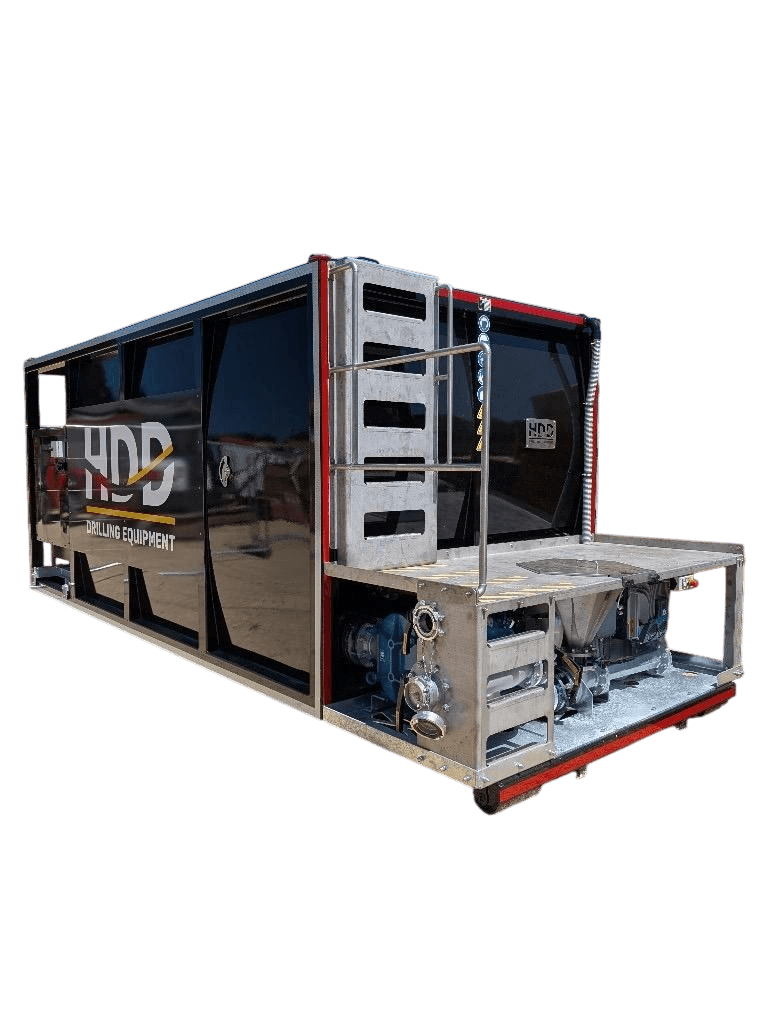
Give the mix at least 15 minutes in the tank before you pump it. In water below 10 degrees Celsius, double that. A MudForce 2500 circulates the tank in about three minutes, so 15 minutes means five full passes through the venturi.
Setting up the venturi
- Keep the hopper half full so the venturi pulls a steady stream of powder
- Watch the vacuum gauge: a drop means the nozzle is clogging
- Flush the hopper and the line after every batch, before the bentonite sets
Quick reference
| Ground | Bentonite per 1,000 l | Marsh funnel |
|---|---|---|
| Sand | 40 kg | 45 to 55 s |
| Clay | 25 kg | 35 to 40 s |
| Cobbles | 50 kg plus polymer | 55 to 70 s |
These are starting points. The return flow tells you within an hour whether the mix is right: clear returns mean the cake holds, muddy returns mean it does not.
Written by Service team HDD Drilling Equipment
The engineers who build, test and service the mixing units in Nijverdal.